Facelift in Singapore (2026): Types, Recovery, Risks and Prices
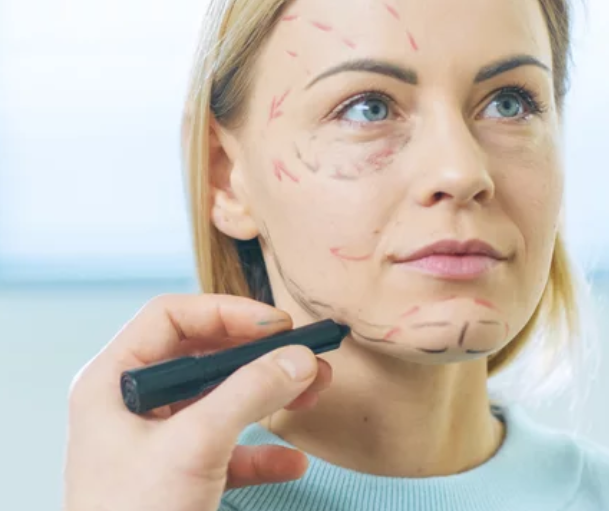
Sagging around the jawline and neck is one of the most common reasons people in Singapore look into a facelift. The choices now range from full surgery to “lunchtime” lifts, and the marketing often blurs them together. This guide explains the types of facelift, what recovery and results really look like, the risks, what it costs, and when a non-surgical option is enough.
Why the face sags with age
Ageing affects every layer of the face. The facial bones gradually change shape, the fat pads lose volume and slide downward, the ligaments that hold soft tissue in place weaken, and the skin thins as collagen breaks down — accelerated by sun exposure and smoking1. That’s why no single treatment fixes everything: a facelift repositions tissue, while fillers and collagen stimulators restore volume.
Types of facelift
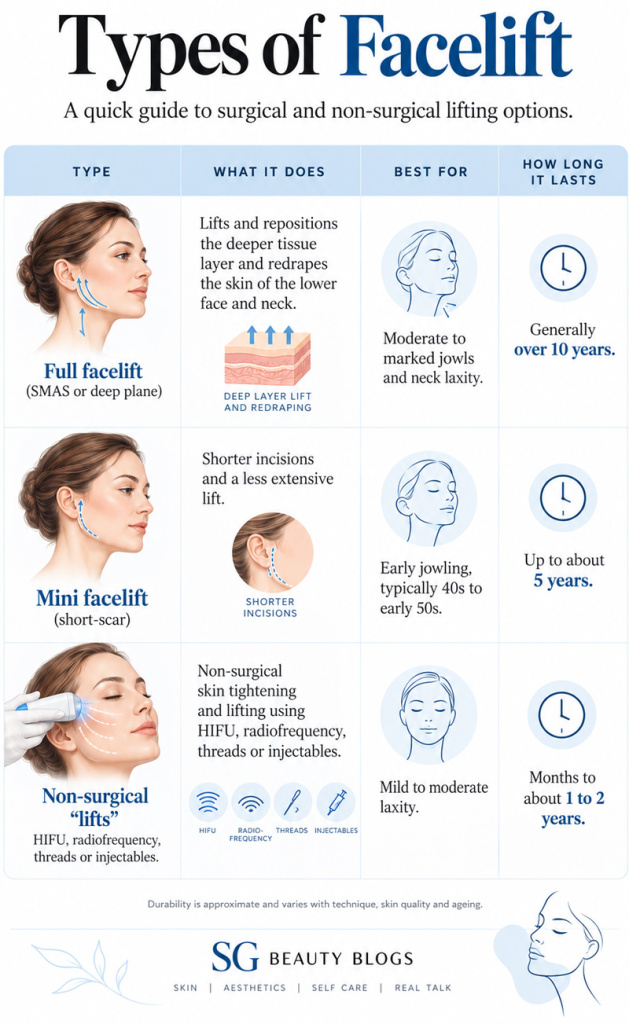
| Type | What it does | Best for | How long it lasts |
|---|---|---|---|
| Full facelift (SMAS or deep plane) | Lifts and repositions the deeper tissue layer and redrapes the skin of the lower face and neck | Moderate to marked jowls and neck laxity | Generally over 10 years |
| Mini facelift (short-scar) | Shorter incisions, less extensive lift | Early jowling, typically 40s–early 50s | Up to about 5 years |
| Non-surgical “lifts” | HIFU, radiofrequency, threads or injectables | Mild-to-moderate laxity | Months to about 1–2 years |
Durability from The Aesthetic Society; individual results vary with technique, skin quality and ageing.
What recovery looks like
- The operation: usually 2–3 hours, often under general anaesthetic, with an overnight stay2
- Stitches: removed at about 7–14 days2
- Bruising and swelling: at least 2 weeks; most people feel presentable after 10–14 days
- Back to desk work: typically 2–3 weeks
- Final result: 6–9 months as swelling fully settles2
Risks: what the data actually shows
In a study of more than 11,000 facelift patients, major complications occurred in 1.8% overall — 1.5% for a facelift alone, rising to 3.7% when combined with other procedures3. The most common was a haematoma (bleeding under the skin, about 1.1%), which was nearly four times more likely in men. Infection was rare (0.3%). Risk was higher in men, in people with a higher BMI, and when several procedures were combined3.
Facial nerve injury is a recognised risk: a 2025 systematic review put it at roughly 2–3% on average, with most cases temporary and recovering within months, and permanent injury rare. Other risks include visible scarring, hair loss near the incisions, asymmetry and blood clots2.
- Under Singapore Medical Council guidelines, a facelift is an invasive procedure that only plastic surgeons, ENT surgeons with facial plastic training, or oculoplastic-trained ophthalmologists may perform4
- Look the surgeon up on the SMC register of doctors and confirm they are a registered specialist
- “Aesthetic surgeon” is not a recognised specialist title in Singapore
- Expect a consultation and a cooling-off period before surgery
Facelift price in Singapore (2026)
| Procedure | Published prices | Source |
|---|---|---|
| Surgical facelift (full or mini) | S$10,000–30,000 | Dream Plastic Surgery |
| Surgical facelift, named surgeons | from S$6,000 to from S$12,888 | WhatClinic listings |
| Mini facelift | from about S$5,000 | WhatClinic; Sozo |
| Non-surgical “facelift” treatments | about S$800–6,000 | Dream Plastic Surgery |
For reference, the Ministry of Health’s fee benchmarks for medically indicated cases put the surgeon’s fee alone at S$11,200–16,800 for a partial facelift and S$15,600–21,300 for a total facelift, before anaesthetist and hospital charges5. MediSave generally can’t be used for cosmetic surgery.
Non-surgical alternatives
HIFU (microfocused ultrasound)
A systematic review found most patients improved, mostly mildly to moderately, with effects lasting up to about a year; the authors suggest surgery for severe laxity. See our guides to HIFU in Singapore and Ultraformer vs Ultherapy. Doctor-led HIFU is available at clinics such as Nee Soon Clinic.
Thread lifts
Less downtime than surgery, but results are more modest and shorter-lived. A meta-analysis reported swelling in about a third of patients, dimpling in about 10% and infection in about 2%. See our thread lift guide.
Collagen stimulators and fillers
Restore lost volume rather than lift tissue, so they complement rather than replace a facelift. See Sculptra price in Singapore and our dermal fillers guide.
Frequently asked questions
How much is a facelift in Singapore?
Published prices range from about S$6,000 to over S$30,000 depending on the type of facelift, the surgeon and the hospital. Mini facelifts start from around S$5,000.
How long does a facelift last?
A full facelift generally lasts over ten years; a mini facelift up to about five. You continue to age, so results gradually soften.
Is a facelift dangerous?
Serious complications are uncommon — about 1.5–2.5% in large studies — and risk is higher in men, people with a higher BMI, and when combining procedures. Choosing an accredited specialist matters.
Can I avoid surgery?
For mild-to-moderate sagging, HIFU, threads or injectables may be enough. For marked jowls and neck laxity, surgery gives the clearest results.
References
- Farkas JP, Pessa JE, Hubbard B, Rohrich RJ. The science and theory behind facial aging. Plastic and Reconstructive Surgery Global Open. 2013;1(1):e8. PMC
- NHS. Facelift. nhs.uk
- Preoperative risk factors and complication rates in facelift: analysis of 11,300 patients. Aesthetic Surgery Journal. 2016;36(1):1–13. PubMed
- Singapore Medical Council. Guidelines on Aesthetic Practices for Doctors. 2016. smc.gov.sg
- Ministry of Health. Fee benchmarks (1 January 2025). go.gov.sg
Prices were correct when checked in October 2026 and may change. This article is for general information and is not medical advice.
Sagging around the jawline and neck is one of the most common reasons people in Singapore look into a facelift. The choices now range from full surgery to “lunchtime” lifts, and the marketing often blurs them together. This guide explains the types of facelift, what recovery and results really look like, the risks, what it costs, and when a non-surgical option is enough.
Why the face sags with age
Ageing affects every layer of the face. The facial bones gradually change shape, the fat pads lose volume and slide downward, the ligaments that hold soft tissue in place weaken, and the skin thins as collagen breaks down — accelerated by sun exposure and smoking1. That’s why no single treatment fixes everything: a facelift repositions tissue, while fillers and collagen stimulators restore volume.
Types of facelift
| Type | What it does | Best for | How long it lasts |
|---|---|---|---|
| Full facelift (SMAS or deep plane) | Lifts and repositions the deeper tissue layer and redrapes the skin of the lower face and neck | Moderate to marked jowls and neck laxity | Generally over 10 years |
| Mini facelift (short-scar) | Shorter incisions, less extensive lift | Early jowling, typically 40s–early 50s | Up to about 5 years |
| Non-surgical “lifts” | HIFU, radiofrequency, threads or injectables | Mild-to-moderate laxity | Months to about 1–2 years |
Durability from The Aesthetic Society; individual results vary with technique, skin quality and ageing.
What recovery looks like
- The operation: usually 2–3 hours, often under general anaesthetic, with an overnight stay2
- Stitches: removed at about 7–14 days2
- Bruising and swelling: at least 2 weeks; most people feel presentable after 10–14 days
- Back to desk work: typically 2–3 weeks
- Final result: 6–9 months as swelling fully settles2
Risks: what the data actually shows
In a study of more than 11,000 facelift patients, major complications occurred in 1.8% overall — 1.5% for a facelift alone, rising to 3.7% when combined with other procedures3. The most common was a haematoma (bleeding under the skin, about 1.1%), which was nearly four times more likely in men. Infection was rare (0.3%). Risk was higher in men, in people with a higher BMI, and when several procedures were combined3.
Facial nerve injury is a recognised risk: a 2025 systematic review put it at roughly 2–3% on average, with most cases temporary and recovering within months, and permanent injury rare. Other risks include visible scarring, hair loss near the incisions, asymmetry and blood clots2.
- Under Singapore Medical Council guidelines, a facelift is an invasive procedure that only plastic surgeons, ENT surgeons with facial plastic training, or oculoplastic-trained ophthalmologists may perform4
- Look the surgeon up on the SMC register of doctors and confirm they are a registered specialist
- “Aesthetic surgeon” is not a recognised specialist title in Singapore
- Expect a consultation and a cooling-off period before surgery
Facelift price in Singapore (2026)
| Procedure | Published prices | Source |
|---|---|---|
| Surgical facelift (full or mini) | S$10,000–30,000 | Dream Plastic Surgery |
| Surgical facelift, named surgeons | from S$6,000 to from S$12,888 | WhatClinic listings |
| Mini facelift | from about S$5,000 | WhatClinic; Sozo |
| Non-surgical “facelift” treatments | about S$800–6,000 | Dream Plastic Surgery |
For reference, the Ministry of Health’s fee benchmarks for medically indicated cases put the surgeon’s fee alone at S$11,200–16,800 for a partial facelift and S$15,600–21,300 for a total facelift, before anaesthetist and hospital charges5. MediSave generally can’t be used for cosmetic surgery.
Non-surgical alternatives
HIFU (microfocused ultrasound)
A systematic review found most patients improved, mostly mildly to moderately, with effects lasting up to about a year; the authors suggest surgery for severe laxity. See our guides to HIFU in Singapore and Ultraformer vs Ultherapy.
Thread lifts
Less downtime than surgery, but results are more modest and shorter-lived. A meta-analysis reported swelling in about a third of patients, dimpling in about 10% and infection in about 2%. See our thread lift guide.
Collagen stimulators and fillers
Restore lost volume rather than lift tissue, so they complement rather than replace a facelift. See Sculptra price in Singapore and our dermal fillers guide.
Frequently asked questions
How much is a facelift in Singapore?
Published prices range from about S$6,000 to over S$30,000 depending on the type of facelift, the surgeon and the hospital. Mini facelifts start from around S$5,000.
How long does a facelift last?
A full facelift generally lasts over ten years; a mini facelift up to about five. You continue to age, so results gradually soften.
Is a facelift dangerous?
Serious complications are uncommon — about 1.5–2.5% in large studies — and risk is higher in men, people with a higher BMI, and when combining procedures. Choosing an accredited specialist matters.
Can I avoid surgery?
For mild-to-moderate sagging, HIFU, threads or injectables may be enough. For marked jowls and neck laxity, surgery gives the clearest results.
References
- Farkas JP, Pessa JE, Hubbard B, Rohrich RJ. The science and theory behind facial aging. Plastic and Reconstructive Surgery Global Open. 2013;1(1):e8. PMC
- NHS. Facelift. nhs.uk
- Preoperative risk factors and complication rates in facelift: analysis of 11,300 patients. Aesthetic Surgery Journal. 2016;36(1):1–13. PubMed
- Singapore Medical Council. Guidelines on Aesthetic Practices for Doctors. 2016. smc.gov.sg
- Ministry of Health. Fee benchmarks (1 January 2025). go.gov.sg
Prices were correct when checked in October 2026 and may change. This article is for general information and is not medical advice.


