Permanent Hair Loss Treatment: Is There a Cure That Lasts?
“Is there a permanent hair loss treatment?” is one of the most common questions people ask before booking a consultation in Singapore — and one of the most often oversold. The honest answer depends on what kind of hair loss you have.
This guide explains which hair loss is permanent and which isn’t, what each treatment can and can’t do long term, and where a transplant fits. For every option ranked by evidence, see our guide to hair loss treatments in Singapore.
Two kinds of hair loss: scarring and non-scarring
Doctors divide hair loss into two broad groups, and the word “permanent” means something different in each.
- Non-scarring hair loss — pattern hair loss (androgenetic alopecia), shedding after illness or childbirth (telogen effluvium) and alopecia areata. The follicles are still alive, so hair can regrow with the right treatment, or on its own once a trigger passes.
- Scarring (cicatricial) alopecia — a group of inflammatory conditions in which the hair follicle is destroyed and replaced by scar tissue. A follicle lost this way will not regrow hair1.
So for most people the question isn’t whether hair loss is permanent — it’s whether a treatment’s effect is. For pattern hair loss, which is by far the most common cause, that distinction is the whole story.
Pattern hair loss: why medication isn’t a permanent fix
Pattern hair loss is progressive. Hormone-sensitive follicles on the top of the scalp gradually shrink and produce finer, shorter hairs. In the large finasteride trials, men on placebo continued to lose hair steadily over two years2. Medications slow or partly reverse this process, but they don’t change the underlying sensitivity of the follicles.
Minoxidil (topical or low-dose oral)
Prolongs the growth phase of the hair and can thicken miniaturised hairs in both men and women. The American Academy of Dermatology is clear: if you stop, you lose its benefits3. The European S3 guideline notes that increased shedding usually starts about three months after stopping4.
- Permanent? No — it works for as long as you use it.
Finasteride and dutasteride (men)
Prescription tablets that reduce the hormone DHT, which drives pattern hair loss in men. Finasteride slowed hair loss and increased hair counts over two years in the pivotal trials2, but once you stop taking it, hair loss starts again3. Dutasteride works in a similar way and is used off-label by some doctors. Both need a doctor’s assessment, and neither is suitable for anyone who is or may become pregnant.
- Permanent? No — the effect lasts only while you take it.
Long-term medication isn’t a failure — for most people it’s the most effective, lowest-cost way to keep their hair. For how doctors build a step-by-step plan, see our androgenetic alopecia treatment protocol. Options differ by sex, so see our guides to male hair loss treatments and hair loss in women.
Hair transplant: the closest thing to permanent
A hair transplant moves follicles from the back and sides of the scalp — which are resistant to pattern hair loss — to thinning areas. Those follicles keep their resistance after they’re moved, a principle known as donor dominance. In suitable patients with a good donor supply, the European S3 guideline says a transplant can permanently improve pattern hair loss by up to three stages on the Norwood-Hamilton scale4. The AAD also describes it as a potentially permanent solution3.
There are two main techniques. FUT removes a thin strip of scalp from the back of the head, leaving a linear scar hidden by surrounding hair. FUE extracts follicles one by one, leaving tiny dot scars and allowing very short hairstyles.
The limits of “permanent”
- Donor supply is finite. You can only move the hair you have, and more than one session is often needed — sometimes only the most visible areas can be covered4.
- Your native hair keeps thinning. The transplanted hair stays, but the hair around it can continue to thin, which may mean further surgery or medication later4.
- Medication is usually still needed. The S3 guideline suggests combining a transplant with finasteride in men for a better result4.
- Not everyone is a candidate. Not all hair loss is suitable for surgery — limited donor hair, ongoing shedding, active scarring alopecia and unrealistic expectations can rule it out4,5.
- Results take time. Transplanted hair usually sheds first and regrows over several months.
In Singapore, FUE is priced per graft. Published rates include S$4–8 per graft, with an average total of around S$10,000 (SL Aesthetic), and from S$5 per graft, with a typical total of S$6,000–15,000 (Veritas). Add the cost of ongoing medication. For a full cost breakdown, including price per graft and how many grafts you might need, see our hair transplant cost guide.
Scarring alopecia: the hair loss that is permanent
Scarring alopecias include lichen planopilaris, frontal fibrosing alopecia, central centrifugal cicatricial alopecia and discoid lupus. They’re less common than pattern hair loss, but they’re the type where delay costs the most. Because destroyed follicles cannot regrow, the aim of treatment is to stop the inflammation before more follicles are lost1. Treatment usually involves prescription anti-inflammatory medicines, and the response is often incomplete.
Once the condition has been inactive for some time, a hair transplant may be used to cover bald patches — but only if there is enough healthy donor hair and the disease is no longer active1.
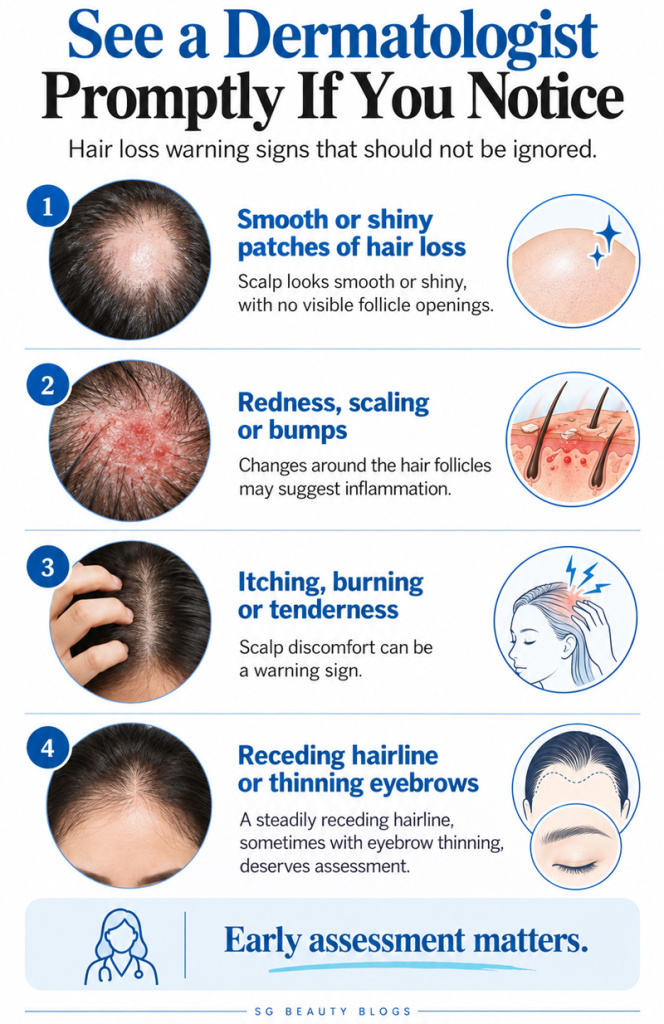
- Patches of hair loss where the scalp looks smooth or shiny, with no visible follicle openings
- Redness, scaling or bumps around the hair follicles
- Itching, burning or tenderness of the scalp
- A hairline that is steadily receding, sometimes with thinning eyebrows
These can be signs of scarring alopecia, which often needs a scalp biopsy to confirm. Scalp centre treatments are not a substitute for medical care here.
What isn’t a permanent hair loss treatment
PRP (platelet-rich plasma)
Injections of your own concentrated platelets. Some studies show a benefit, but preparation methods vary widely and good long-term data is lacking4. A typical course involves monthly sessions at first, then repeat treatments every three to six months3.
Low-level laser therapy
Laser caps, combs and in-clinic devices can be a reasonable add-on, but they require many sessions and ongoing use to maintain any benefit3.
Exosomes and other “regenerative” treatments
Widely marketed in Singapore, but human studies in hair loss are still small and early. There is no evidence yet that they produce permanent regrowth.
Shampoos, serums and scalp treatments
These can improve an oily, flaky or irritated scalp and make hair look fuller, but they don’t reverse pattern hair loss. See our guide to hair thinning treatment in Singapore for where these fit.
Permanent or not? At a glance
| Treatment | Permanent? | What it does | Maintenance |
|---|---|---|---|
| Hair transplant (FUE/FUT) | Closest to permanent | Moves loss-resistant follicles to thinning areas | Usually medication to protect native hair; sometimes further sessions |
| Minoxidil | No | Prolongs hair growth and thickens fine hairs | Daily, indefinitely |
| Finasteride / dutasteride | No | Lowers DHT to slow pattern hair loss in men | Daily, indefinitely |
| PRP | No | Platelet injections that may support hair growth | Repeat every 3–6 months after initial course |
| Low-level laser | No | Light therapy as an add-on | Ongoing, regular sessions |
| Exosomes | No evidence | Experimental “regenerative” injections | Unclear |
| Shampoos and scalp treatments | No | Improve scalp condition and appearance | Ongoing |
| Treatment for scarring alopecia | Stops further loss; doesn’t regrow lost hair | Controls follicle inflammation | As directed by a dermatologist |
- Get a diagnosis first — scarring, patterned or shedding hair loss are treated very differently
- For pattern hair loss, start medication early: it’s easier to keep hair than to regrow it
- If you’re considering a transplant, ask how much donor hair you have and how the plan accounts for future loss
- Find dermatologists and transplant doctors in our hair loss clinic directory
Frequently asked questions
Is there a permanent cure for hair loss?
Not for pattern hair loss. Medication controls it only while you use it. A hair transplant gives long-lasting results in the treated area, but your remaining hair can keep thinning.
Is a hair transplant permanent?
The transplanted follicles generally keep growing for life because they come from areas resistant to pattern hair loss. Most people still need medication to protect their own hair around the grafts.
What happens if I stop minoxidil or finasteride?
Hair loss resumes, usually within a few months, and you gradually lose the hair the medication was maintaining.
Can permanent hair loss grow back?
Not where scarring alopecia has destroyed the follicles. Early treatment can stop it spreading, and a transplant may be possible once the condition is inactive.
How much is a permanent hair loss treatment in Singapore?
Published FUE hair transplant prices range from about S$4–8 per graft, with typical totals of around S$6,000–15,000 at the clinics we checked, plus ongoing medication.
References
- Filbrandt R, Rufaut N, Jones L, Sinclair R. Primary cicatricial alopecia: diagnosis and treatment. CMAJ. 2013;185(18):1579–85. PMC
- Kaufman KD, et al. Finasteride in the treatment of men with androgenetic alopecia. Journal of the American Academy of Dermatology. 1998;39(4 Pt 1):578–89. PubMed
- American Academy of Dermatology. Hair loss: Diagnosis and treatment. 2022. aad.org
- Kanti V, et al. Evidence-based (S3) guideline for the treatment of androgenetic alopecia in women and in men. Journal of the European Academy of Dermatology and Venereology. 2018;32(1):11–22. PubMed; full guideline
- Jimenez F, Alam M, Vogel JE, Avram M. Hair transplantation: basic overview. Journal of the American Academy of Dermatology. 2021;85(4):803–814. PubMed
Prices were correct when checked in October 2026 and may change. This article is for general information and is not medical advice.