Postpartum Hair Loss in Singapore (2026): How Long It Lasts & What Helps
A few months after the baby arrives, many new mums in Singapore notice hair coming out in handfuls — in the shower drain, on the pillow, around the hairline. It’s alarming, especially when you’re already short on sleep. The good news is that for most women it’s temporary. This guide explains why it happens, how long it lasts, what helps, what’s safe while breastfeeding, and when to get it checked.
What is postpartum hair loss?
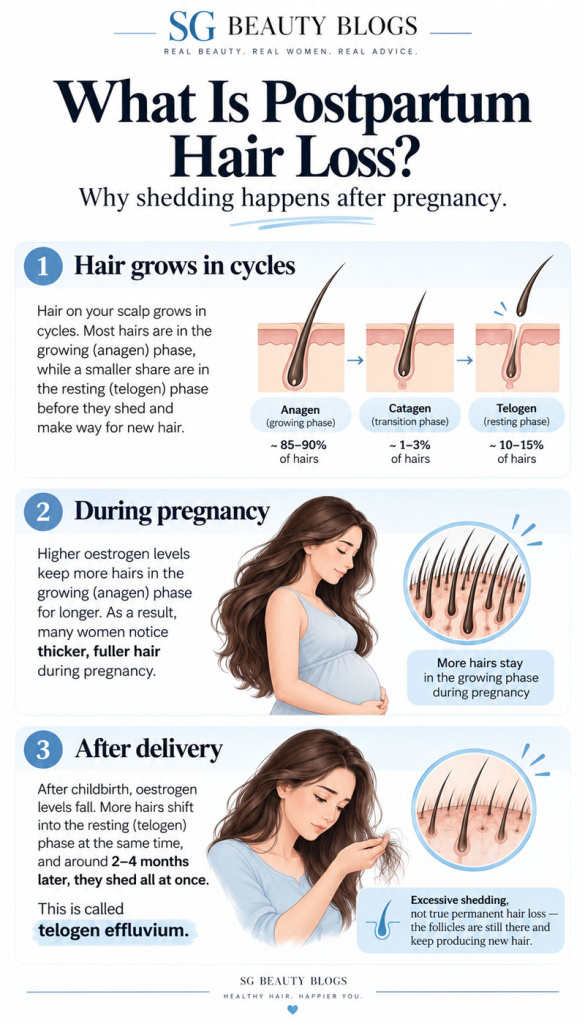
Hair grows in cycles. At any time, most hairs are in the growing (anagen) phase and a smaller share are in the resting (telogen) phase before they fall out. High oestrogen levels in pregnancy keep more hairs in the growing phase, so many women notice thicker hair. After delivery, oestrogen falls and a large number of hairs move into the resting phase together. Two to four months later, they shed at once12.
Dermatologists call this telogen effluvium — excessive shedding rather than true hair loss. The follicles are still there and keep producing new hair1.
When does it start and stop?
| Stage | Typical timing | What you notice |
|---|---|---|
| Start | A few months after delivery | More hair in the shower, brush and pillow |
| Peak | Around 4 months postpartum | Heaviest shedding; thinner temples and hairline |
| Regrowth | As shedding slows | Short, fine “baby hairs” along the hairline |
| Back to normal | By your child’s first birthday for most women | Normal fullness returns1 |
How common it is and how much hair is lost varies a lot between women. A 2016 review of the published data found that the studies behind the condition are surprisingly thin, so the exact incidence isn’t known3. In practice, what matters is whether your shedding settles on schedule.
Is it postpartum shedding or something else?
Shedding after a birth can overlap with, or unmask, other causes of hair loss. Common ones after pregnancy include2:
- Iron deficiency, from blood loss at delivery or low iron stores
- Thyroid problems, including postpartum thyroiditis
- Female pattern hair loss, which can show up for the first time after pregnancy — a widening parting rather than all-over shedding
- Tight hairstyles such as tight ponytails worn to keep hair away from the baby
- Shedding is still heavy about a year after delivery1
- Your parting is widening or you can see more scalp at the crown
- You have round bald patches, a red or scaly scalp, or feel unusually tired, cold or breathless
A blood test for iron and thyroid function is quick and often the most useful first step.
What helps postpartum hair loss?
Because the shedding settles by itself, the aim is to look fuller while you wait and to avoid making things worse. The American Academy of Dermatology suggests1:
- A volumising shampoo rather than a heavy “conditioning shampoo”
- A light conditioner for fine hair, applied mainly to the ends
- Skipping intensive conditioners, which weigh fine hair down
- A shorter or layered cut that adds volume and is easier to manage
Also helpful: loose hairstyles, gentle brushing, keeping up a balanced diet, and continuing any prenatal vitamins your doctor recommended.
Daily scalp care
Singapore’s humidity means sweat and oil build up quickly, and a comfortable, clean scalp makes shedding easier to live with. A gentle, sulfate-free shampoo you’re happy to use often is a good base. The elihe AmpliHair Hair Loss Shampoo (S$45, usually S$54) is sulfate- and silicone-free, and the elihe AmpliHair Hair Growth Ampoule (S$108, usually S$135) is a drug-free leave-on. If you’re breastfeeding, check any leave-on product with your doctor. For more options, see our guide to the best scalp serum in Singapore.
Is minoxidil safe while breastfeeding?
Minoxidil is the best-proven treatment for pattern hair loss, but it isn’t needed for ordinary postpartum shedding. If a doctor suggests it, for example because pattern hair loss has been unmasked:
- The US National Library of Medicine’s LactMed database considers topical minoxidil acceptable once breastfeeding is established, but advises avoiding contact between the baby and treated skin, as absorption can cause excess hair growth in the infant4.
- Oral minoxidil should be used with caution while breastfeeding, especially with a newborn4.
- Other hair loss medicines are more limited while breastfeeding because some pass into breast milk; a 2025 dermatology review sets out which are compatible5.
Product labels can be stricter than the medical literature, so always check with your doctor or pharmacist.
Postpartum hair loss treatment in Singapore
| Option | Best for | Notes |
|---|---|---|
| GP or polyclinic | Blood tests (iron, thyroid); referral | Needed for a subsidised National Skin Centre appointment |
| Dermatologist / National Skin Centre | Shedding beyond a year; suspected pattern loss | Diagnosis and prescription treatment; subsidised first visit about S$30–71 with referral |
| Scalp centres | Scalp comfort and support while hair recovers | Non-prescription, device-based treatments — see scalp treatment in Singapore |
Consultation and treatment costs are compared in our hair loss treatment Singapore price guide.
Anagen Scalp — Pacific Plaza, Orchard
Anagen Scalp runs a dedicated Post Partum Plasma Boost for women within 12 months of giving birth. It starts with an AI scalp analysis, then combines plasma energy, a plant-based phyto-oestrogen complex and an exosome serum, with a cooling finish. It’s drug-free, needle-free and has no downtime; sessions take 60–90 minutes, and the centre recommends 8–12 sessions for visible thickening. Read more on its postpartum hair loss guide.
- Price: Plasma Scalp Boost S$380 per session; first trial S$38, including a scalp analysis
- Address: 9 Scotts Road, #03-11/12 Pacific Plaza, Singapore 228210
- Contact: 6235 0362 · WhatsApp 8351 3191
- Hours: Mon–Fri 10.30am–8pm; Sat–Sun 10am–7pm
Scalp centre treatments don’t replace a medical check if your shedding isn’t settling. For more providers, see our hair loss clinic Singapore directory, and for longer-term thinning, our guide to hair loss treatment for women in Singapore.
Frequently asked questions
How long does postpartum hair loss last?
Shedding usually peaks around four months after delivery, and most women have their normal fullness back by their baby’s first birthday.
Will my hair grow back after pregnancy?
Yes, in most cases. The follicles aren’t damaged, and new hairs start growing as the shed ones fall out. If it hasn’t recovered after a year, see a doctor.
Can I prevent postpartum hair loss?
Not really — it’s driven by the drop in hormones after birth. You can reduce breakage with loose styles and gentle care, and make sure iron and thyroid problems are picked up.
Does breastfeeding cause hair loss?
Postpartum shedding happens whether or not you breastfeed. Breastfeeding does affect which treatments are suitable, so check with your doctor before starting any medicine.
References
- American Academy of Dermatology. Hair loss in new moms. aad.org
- Grover C, Khurana A. Telogen effluvium. Indian J Dermatol Venereol Leprol. 2013;79(5):591–603. PubMed
- Mirallas O, Grimalt R. The postpartum telogen effluvium fallacy. Skin Appendage Disord. 2016;1(4):198–201. PubMed
- Drugs and Lactation Database (LactMed). Minoxidil. National Institute of Child Health and Human Development. PubMed
- Needle CD, Brinks AL, Kearney CA, et al. Alopecia treatments in breastfeeding: safety and clinical considerations. Int J Dermatol. 2025;64(12):2215–2234. PubMed
Information and prices were correct when checked in October 2026 and may change. This article is for general information and is not medical advice.


